
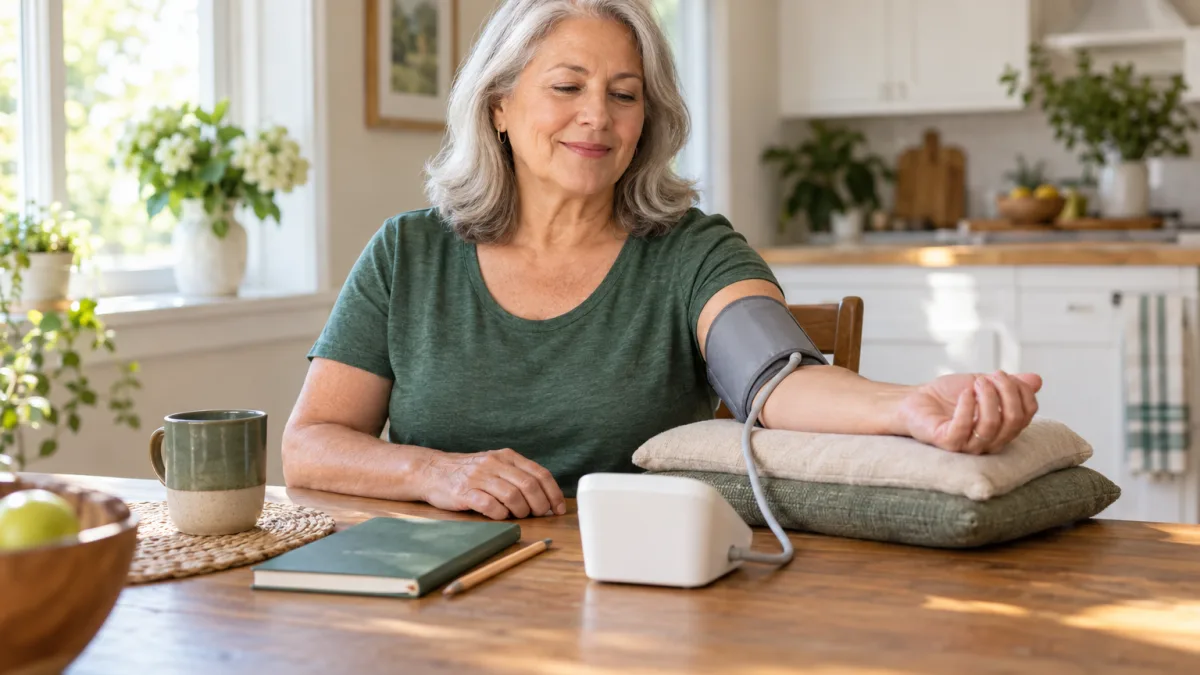
How often to check blood pressure at home depends on the schedule you set with your healthcare team, according to the Centers for Disease Control and Prevention (CDC). For a short tracking period before an appointment, the American Heart Association’s blood pressure log calls for two readings, one minute apart, in the morning and at bedtime for at least three days, preferably seven.
A home monitor can leave you with questions: Should you check every day? Is once a week enough? The goal is a clear routine you and your care team can use—not repeated checks without a plan.
What schedule fits your blood pressure readings?
The American Heart Association (AHA) defines the categories below. These describe readings; your clinician should help decide your monitoring schedule. The top number is systolic pressure, and the bottom number is diastolic pressure.
| Reading or situation | AHA category or guidance | Home-monitoring approach |
|---|---|---|
| Normal | Top number below 120 and bottom number below 80 mm Hg | Ask whether home checks are needed and how often. |
| Elevated | Top number 120–129 and bottom number below 80 mm Hg | Agree on a schedule with your care team. |
| Stage 1 hypertension range | Top number 130–139 or bottom number 80–89 mm Hg | Share readings with your clinician and ask about a short tracking period. |
| Stage 2 hypertension range | Top number 140 or higher or bottom number 90 or higher mm Hg | Contact your clinician to arrange review and a monitoring plan. |
| Starting or changing treatment | AHA especially recommends home monitoring | Ask when to start, how often to check, and when to send results. |
| Well-controlled blood pressure | Frequency is set by your healthcare professional | Mayo Clinic says once daily or less often may be appropriate when your clinician advises it. |
The AHA recommends home monitoring for everyone with hypertension, especially when treatment starts or changes. Mayo Clinic also identifies home monitoring as especially important for people with elevated blood pressure, diabetes, or kidney disease. If any applies to you, ask for a schedule that fits your care plan.
For routine screening, the National Heart, Lung, and Blood Institute (NHLBI) recommends a healthcare-provider blood pressure check at least once a year. Keep that visit separate from any home routine your clinician recommends.
Why are several readings more useful than one?
According to Mayo Clinic, blood pressure changes during the day, and morning readings are often somewhat higher. The AHA describes a single reading as a snapshot. A series of recorded readings helps a clinician assess how treatment is working.
Home and office readings can also differ. NHLBI explains that “white-coat hypertension” means readings are higher in a healthcare office than outside it. “Masked hypertension” means office readings can be lower than readings elsewhere.
If the numbers do not match, bring your log rather than choosing which set to trust. NHLBI says clinicians can compare home and office measurements to investigate the difference.
How many readings should you take each time?
The CDC recommends taking at least two readings, one or two minutes apart. For the AHA’s pre-appointment routine, take two readings one minute apart at each session.
That means two sessions each day: one in the morning and one at bedtime. Each session includes a pair of readings. You do not need four separate check-in times to follow that routine.
An AHA educational article recommends averaging at least two readings taken one minute apart. If the readings seem widely separated, it advises taking a third and calculating the average. Keep the individual readings as well as the average in your log, and ask your care team how they prefer results recorded.
When should you check, and for how long?
For its pre-appointment log, the AHA recommends morning readings before medication and eating, plus bedtime readings before sleep. The CDC recommends measuring at consistent daily times.
Use the morning check as part of your planned routine, without changing when you take prescribed medication on your own. Talk with your doctor before making medication changes, and do not stop prescribed medication based on home readings.
The AHA’s short tracking block lasts at least three days, with seven days preferred. Use the start and stop dates your clinician gives you, then share the results.
Long-term monitoring may look different. Mayo Clinic says people whose blood pressure is well controlled may be able to check once a day or less often, as directed by their healthcare professional.
After treatment changes, Mayo Clinic says a clinician might recommend starting checks two weeks later and checking during the week before the next appointment. Ask for your own timing rather than assuming every treatment change needs the same schedule.
How can you make each reading more consistent?
The AHA recommends a validated, automatic upper-arm monitor with a cuff that fits your arm circumference. An incorrect cuff size can distort the reading.
Follow this preparation checklist from the CDC:
- Do not eat or drink during the 30 minutes before measuring.
- Avoid smoking and exercise during that period.
- Empty your bladder.
- Sit with your back supported and rest for at least five minutes.
- Keep your feet flat and your legs uncrossed.
- Put the cuff on bare skin.
- Support the cuffed arm at chest height.
- Stay silent while measuring.
Choose a spot where you can sit comfortably and support your arm. Keep your log nearby so recording the result is part of the same task.
The AHA advises bringing your monitor to an appointment so the care team can check your technique and the device’s accuracy. Repeat equipment checks once a year or as the manufacturer directs.
What should you record and look for?
Mayo Clinic lists a notebook or an electronic personal health record as options for tracking. Choose whichever you will find easiest to use and share.
A practical log can include:
- The date and time.
- Each reading from the session.
- The average, if your care team requests it.
- A note about anything unusual during the check, such as talking or rushing.
- Questions you want to ask at your next visit.
Look across the record rather than focusing only on its highest or lowest entry. Are readings often above the goal your clinician gave you? Are they staying above your usual level? Mayo Clinic advises contacting your healthcare team for unusual increases or readings that remain above your usual level.
The AHA’s log includes space for an individual blood pressure goal. It also advises showing the record to your healthcare professional at every visit. Keep recording as directed, including readings that differ from what you expected.
When should you call your clinician or 911?
Ask your clinician in advance what reading should trigger a call. Mayo Clinic recommends having that conversation so you know how to respond to an unusual increase.
For nonpregnant adults, the AHA’s emergency guidance uses a threshold higher than 180/120 mm Hg.
- With chest pain, shortness of breath, back pain, numbness, weakness, vision changes, or difficulty speaking: call 911. Do not wait for the pressure to fall on its own.
- Without new concerning symptoms: wait at least one minute and measure again. If the repeat reading is similarly high, contact a healthcare professional as soon as possible.
Keep these instructions with your log. A home-monitoring schedule should help you act on concerning results, not delay getting help.
What might a clinician-tailored plan look like?
These examples are starting points for a conversation, not fixed schedules for everyone.
An adult whose readings have been normal: Keep the yearly healthcare-provider check recommended by NHLBI. Ask whether home checks would be useful and, if so, how often to take them.
Someone with newly noted readings in the stage 1 range: Contact the clinician and ask whether to use the AHA’s pre-appointment log. If directed, collect paired morning and bedtime readings for at least three days, preferably seven, and arrange review.
Someone with a recent medication dose change: Ask the prescriber to write down when monitoring should begin, how often to check, and when results should be sent. Follow that plan and keep follow-up appointments. The AHA emphasizes that home monitoring does not replace medical visits.
How can you make your monitoring plan a habit?
Make the routine easy to follow. Keep the monitor, a chair with arm support, and your log together. If your plan includes morning and bedtime sessions, tie them to familiar parts of your day.
Before your next appointment, write down the questions that would make your plan clearer:
- Which days and times should I check?
- What is my blood pressure goal?
- When should I send the log?
- What result means I should call?
- When should we review the schedule?
Bring those questions, your log, and your monitor to the visit. If keeping up with checks feels difficult, ask your healthcare team for help making the routine manageable. The most useful next step is a clear plan you understand and can follow.